
There is a tendency in nutrition writing to regard weight as a problem that resolves itself once the correct information is applied. The field notes suggest otherwise. Over several seasons of recording daily food choices in detail, what becomes apparent is that weight awareness is not a destination one arrives at through a single intervention — it is a pattern one observes over many ordinary days, each of which contains dozens of small decisions that accumulate into something legible only in retrospect.
The Ordinary Day as the Unit of Analysis
Most nutritional attention falls on the weekend: the dinner out, the celebratory gathering, the deliberately indulgent Saturday morning. These moments are memorable and therefore countable. But the field journal, maintained across forty-seven consecutive weeks in the most recent cycle, tells a different story. Of the food choices that influenced weight in any given fortnight, fewer than fifteen percent occurred at weekends. The remaining eighty-five percent were made on Tuesday afternoons, Thursday mornings before a meeting, the compressed window between returning home and needing to sleep.
This is not a counterintuitive finding once it is stated clearly. The working week contains far more meals than the weekend. It also contains more cognitive pressure, more time constraints, and more situations in which the friction of cooking from scratch becomes prohibitive. Understanding weight awareness as a weekday question — rather than a weekend one — changes the kinds of adjustments that seem useful.
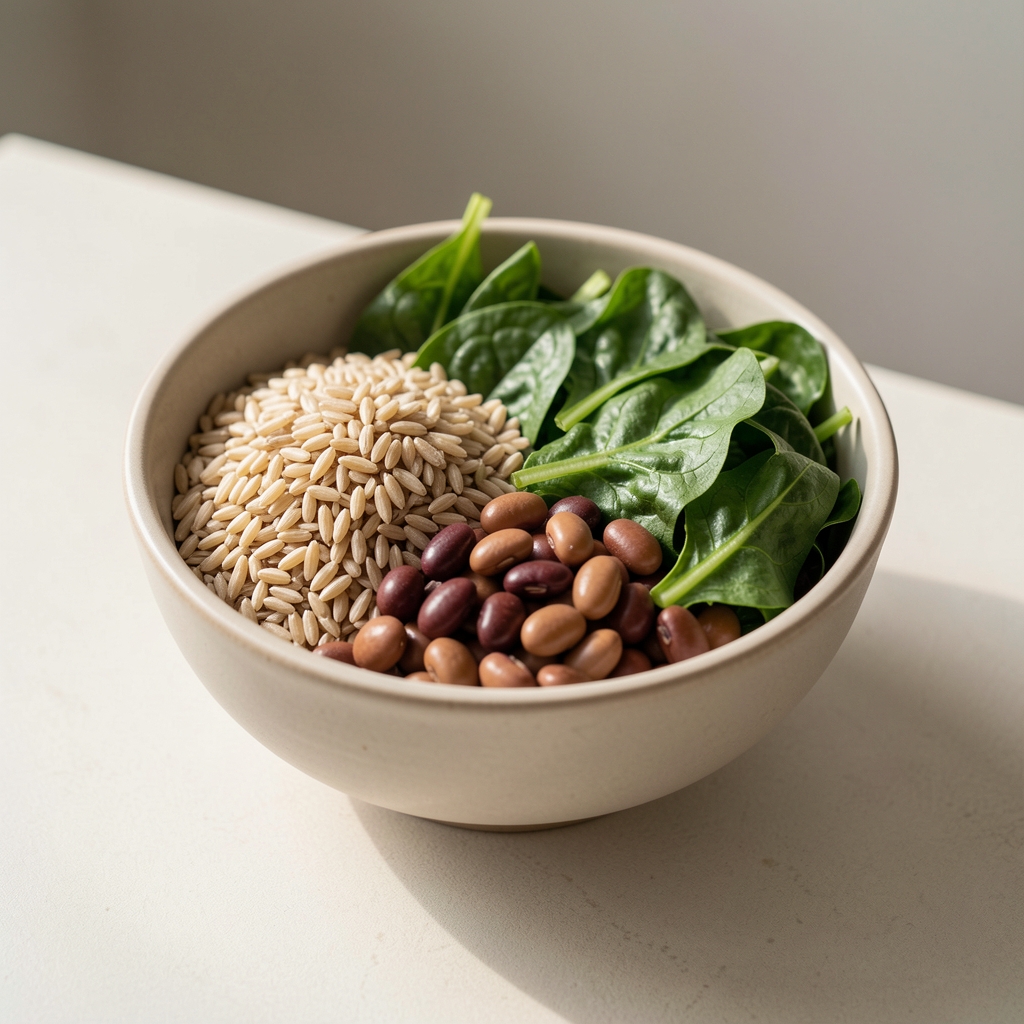
Whole foods arranged for observation — field record, January 2026.
Portion Awareness Without Measurement
The phrase "portion control" carries a mechanical register that tends to put people off. The journal practice that has proven most useful is different in character: it is observational rather than restrictive. Before eating, the practice involves a brief, uncharged assessment of what is on the plate — not in grams, but in rough visual categories. How much of the plate is occupied by vegetables? How dense is the carbohydrate component? Is there a protein source present?
This is not a weighing exercise. It is closer to the kind of spatial awareness one develops when packing a bag — a rough estimate that improves with repetition and requires no tools. The value is not in achieving a particular numerical ratio but in building the habit of noticing. Over weeks, the noticing itself shifts choices. The Wednesday lunch that would previously have been a white-bread sandwich becomes, with almost no resistance, a slightly different construction because the observation practice has made the alternative legible.
Published research on portion awareness as a dietary variable suggests that visual cues — plate size, the visual proportion of food categories, the density of what is presented — are among the more reliable levers available to someone trying to adjust intake without introducing the psychological overhead of strict numerical tracking. This aligns with what the field notes show: the adjustments that have proven most consistent over time are those that require the least ongoing effort.
"The adjustments that persist are not the ones made with the most force. They are the ones that require the least ongoing decision-making to sustain."
Whole Foods as a Structural Default
One of the cleaner patterns visible across the field journal is the relationship between the structural availability of whole foods and the quality of weekday eating. On weeks when the kitchen contained a variety of cooked grains, roasted vegetables, and protein sources prepared in advance, the food choices made under pressure were consistently better than on weeks when those structural defaults were absent.
This is not a novel observation — the idea that food preparation reduces in-the-moment decision fatigue appears across much of the nutrition literature. What the journal adds is granularity: it is not simply the presence of prepared food that changes outcomes, but the specific availability of options that require minimal assembly. A cooked grain and a handful of leaves with a boiled egg requires almost no cognitive engagement to combine. The same grains in a bag of rice that still needs forty minutes on the hob might as well not exist on a Thursday at seven in the evening.
The practical implication is less about meal planning in the formal sense — the elaborate Sunday preparation ritual that magazines promote — and more about maintaining a small, rotating stock of components that reduce friction at the point of decision. Three or four items, changed weekly in line with seasonal produce, appear to be sufficient.
The Weekly Food Rhythm
Weight, observed across seasons rather than days, shows a rhythmic pattern that closely follows the structure of the week. The first half of the week — Monday through Wednesday — tends toward better nutritional balance, lower processed food reliance, and more consistent vegetable intake. From Thursday onward, these metrics begin to shift: cooking from scratch decreases, the structure of meals becomes less regular, and the gravitational pull of convenience options increases.
Recognising this rhythm is itself useful. It suggests that the interventions most likely to influence weight are those that ease the transition into the second half of the week rather than those that attempt to reinforce the already-functional first half. A light preparation on Wednesday evening — not a full cook, but a small act of readiness — tends to have an outsized effect on Thursday and Friday outcomes.
The field journal has tracked this pattern across three consecutive years. The rhythm holds in winter and in summer, in periods of higher activity and in more sedentary phases. It is, in that sense, structural rather than circumstantial: a property of the working week itself rather than of any particular set of conditions.
What the Nutritionist Perspective Adds
A nutritionist's perspective on weight and daily food choices differs from a general public-health framing in its granularity. Where public-health communication tends toward broad categories — "eat more vegetables", "reduce processed food" — the nutritionist's eye is drawn to the specific mechanics of the week: which meals tend to fall short, which preparation patterns reduce friction, which food categories are consistently underrepresented in the journal record.
For the purposes of this archive, the most consistent finding is simple: weight patterns are more strongly correlated with the regularity and structure of ordinary weekday eating than with any specific food type or nutrient category. Nutritional balance, maintained consistently across the week, appears to be more influential than any single high-quality meal. The food journalling practice reinforces this because it makes the pattern visible — and what is visible becomes, gradually, adjustable.
- Weekday food choices account for the majority of weekly nutritional patterns, not weekend eating events.
- Visual portion awareness — noticing plate composition without measurement — builds consistent habits with low ongoing effort.
- Structural availability of whole food components (pre-cooked grains, roasted vegetables, simple proteins) reduces decision fatigue at pressure points in the week.
- The working week has a rhythm: the second half, Thursday onward, is where structural support matters most.
- Food journalling is most useful when it makes patterns visible across multiple weeks rather than tracking individual meals in isolation.